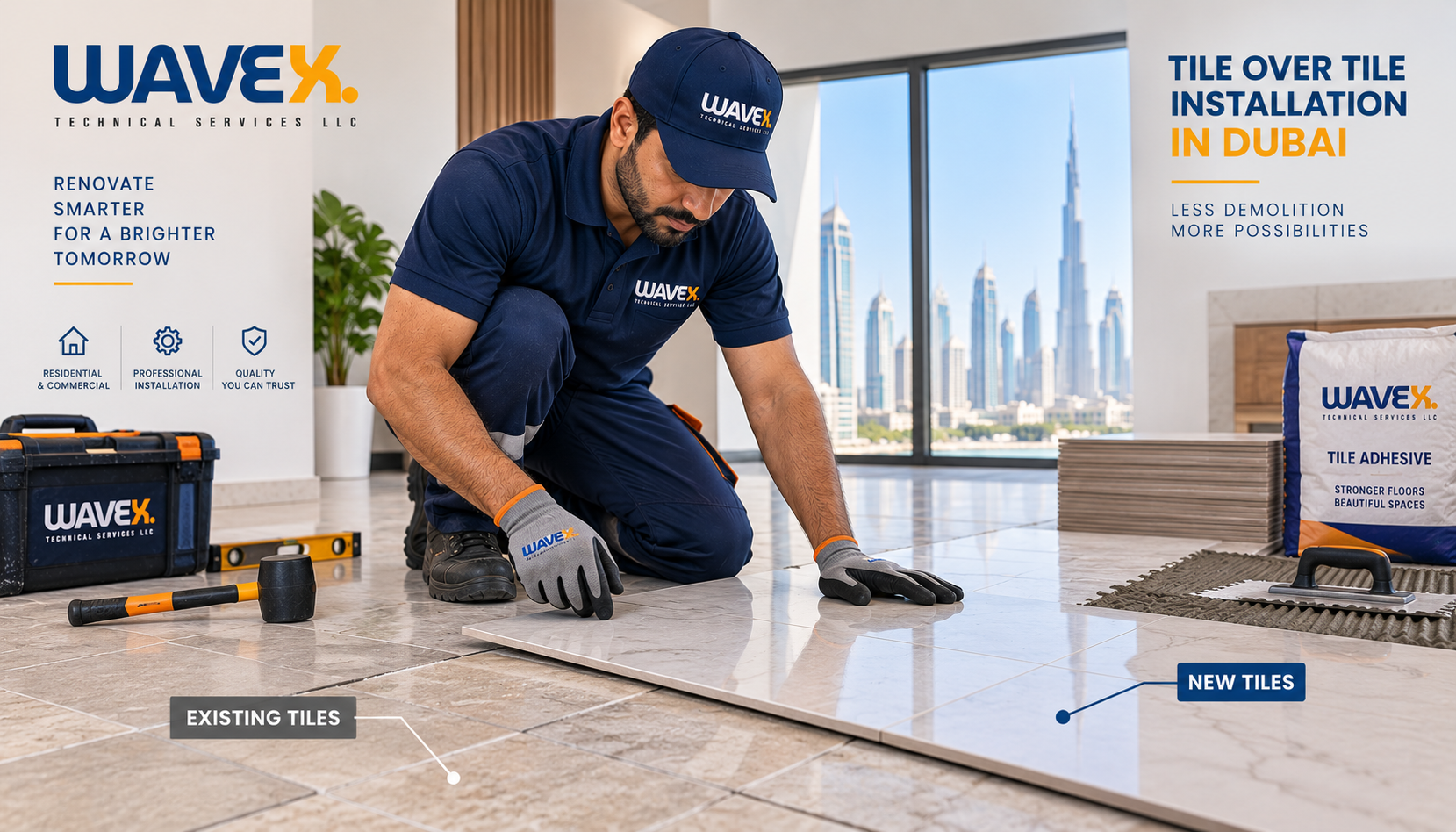
Removing an entire tiled floor can add demolition, debris and preparation work to a renovation project. This leads many property owners to ask: can you install new tiles directly over existing tiles in Dubai?
In suitable conditions, tile over tile installation in Dubai can be possible. However, the existing tiled surface must be carefully assessed before new tiles are installed. Loose tiles, hollow areas, major floor unevenness, moisture problems or an unstable substrate can make installing another layer of tiles inappropriate.
In this guide, Wavex Technical Services explains when tile-over-tile installation may be considered, how the existing floor should be assessed and when removing the old tiles is the better option.
What Is Tile Over Tile Installation?
Tile-over-tile installation means fixing new ceramic or porcelain tiles over an existing tiled surface instead of completely removing the original floor first.
The existing tiles effectively become part of the substrate supporting the new installation.
This means the condition of the old tiled floor is extremely important. If the original tiles are poorly bonded or unstable, adding another layer does not automatically correct the problem underneath.
Can You Tile Over Existing Tiles?
Potentially, yes — but only when site conditions are suitable.
Before recommending tile over tile, experienced tile fixing contractors in Dubai should assess the existing flooring.
The inspection should consider:
- Whether the existing tiles are firmly bonded
- Whether tiles sound hollow or move under pressure
- Condition of existing grout joints
- Cracks in the tiled surface
- Overall floor flatness
- Moisture or leakage concerns
- Door and threshold clearance
- Final floor height
- Transitions to adjoining rooms
- Suitability of the existing surface for bonding
The decision should therefore be based on the condition of the floor rather than simply on whether tile-over-tile installation is technically possible.
When Can Tile Over Tile Be a Suitable Option?
Installing new tiles over an existing tiled floor may be considered when the original installation is stable and provides an appropriate base.
1. Existing Tiles Are Firmly Bonded
The original tiles should be securely attached to the substrate.
If several tiles are already loose, moving or debonded, covering them with another layer can transfer the underlying instability into the new installation.
2. The Existing Floor Is Reasonably Flat
Large high and low areas can make the new tile installation difficult.
This is particularly important when installing large format tiles in Dubai, because larger tiles require careful substrate preparation and consistent support.
3. There Are No Significant Moisture Problems
Visible leakage, persistent dampness or suspected waterproofing problems should be investigated before another flooring layer is added.
Covering the existing tiles does not repair an underlying waterproofing failure.
4. Additional Floor Height Is Acceptable
Installing another tile layer increases the finished floor height.
This can affect doors, thresholds, skirting, kitchen cabinetry, bathroom levels and transitions between rooms.
These details should be checked before work starts.
When Should Existing Tiles Be Removed?
Removing the original flooring may be the more appropriate approach when significant problems already exist.
Examples include:
- Numerous loose tiles
- Large areas of hollow-sounding tiles
- Tiles that move when walked on
- Extensive cracking
- Major floor unevenness
- Damaged substrate
- Moisture or waterproofing concerns
- Floor height restrictions
- Need to inspect or repair the substrate underneath
Removing the old tiles provides access to the underlying floor so that defects can be assessed and corrected before the new finish is installed.
Hollow Tiles Should Be Checked Before Tile-Over-Tile Installation
Hollow-sounding tiles deserve particular attention.
A hollow sound can indicate voids or insufficient bonding beneath sections of the existing tile.
A limited hollow area does not automatically mean the entire floor has failed, but widespread hollow or moving tiles can indicate that the existing installation is not a suitable base for another tile layer.
Read our detailed guide to hollow floor tiles in Dubai for common causes and repair considerations.
How Is an Existing Tiled Floor Prepared?
If tile-over-tile installation is considered suitable, preparation remains essential.
The exact method depends on the existing tile, new tile, adhesive system and site conditions.
Step 1: Inspect the Existing Floor
The first step is checking the existing tiles for movement, cracking, hollow areas and other defects.
Problem areas should not simply be hidden underneath the new floor.
Step 2: Clean the Surface
The tiled surface should be free from dust, grease, construction residue and contaminants that could interfere with adhesion.
A visually clean floor is not always the same as a surface properly prepared for bonding.
Step 3: Prepare the Existing Tile Surface
Depending on the existing surface and the selected installation system, additional preparation may be required to create an appropriate bonding surface.
The adhesive or preparation-product manufacturer's instructions should be followed.
Step 4: Correct Local Defects
Loose or damaged areas should be addressed before installation continues.
If significant defects are discovered during preparation, removing a larger section of the old floor may become necessary.
Step 5: Plan the New Tile Layout
Doorways, walls, corridors and transitions should be considered before fixing begins.
Good layout planning helps avoid narrow cuts and poorly positioned grout joints.
Step 6: Install the New Tiles
A suitable adhesive should be selected for the new tile and prepared existing surface.
Adequate adhesive coverage, alignment and joint spacing remain essential whether tiles are installed over screed or over an existing tiled floor.
Does Tile Over Tile Make the Floor Too High?
This is one of the most important practical considerations.
The finished floor height increases by the combined thickness of the new adhesive and tile.
That increase may affect:
- Internal doors
- Entrance doors
- Balcony thresholds
- Bathroom thresholds
- Kitchen cabinets
- Built-in furniture
- Skirting
- Transitions to untiled rooms
A site inspection should identify these conflicts before the installation begins.
Can You Tile Over Existing Tiles in a Bathroom?
Bathroom tile-over-tile installation requires additional caution because the tiled finish is associated with drainage and waterproofing systems.
If the existing bathroom has leakage, damaged waterproofing, incorrect slopes or other underlying problems, covering the tiles may hide rather than resolve the issue.
Areas around showers, floor drains, sanitary fixtures and wall-floor junctions require particular attention.
If the bathroom requires broader corrective work, a complete bathroom renovation in Dubai may provide better access to repair the underlying system.
Can You Tile Over Existing Wall Tiles?
In some situations, new wall tiles may also be installed over existing tiles, provided the original finish and supporting wall are suitable.
The additional weight of the new installation must be considered, particularly with large porcelain tiles.
The wall should be inspected for:
- Loose existing tiles
- Cracking
- Moisture damage
- Surface contamination
- Wall stability
- Suitability for the weight of the new finish
The selected installation products should also be suitable for the particular application.
Can Large Format Tiles Be Installed Over Existing Tiles?
Potentially, but substrate flatness and stability become even more important.
Large tiles span a greater area and therefore require consistent support underneath.
If the original tiled floor is uneven, loose or poorly bonded, installing oversized porcelain tiles over it may increase the risk of problems.
For more detail, read our large format tile installation guide.
Tile Over Tile vs Removing Existing Tiles
Neither method is automatically the best choice for every project.
Tile over tile may be considered when:
- The existing floor is stable
- Floor levels are acceptable
- There are no major substrate problems
- The surface can be properly prepared
- There are no unresolved moisture concerns
Tile removal may be preferable when:
- Many tiles are loose or hollow
- The floor is significantly uneven
- Underlying repairs are required
- Waterproofing needs attention
- Additional floor height would create problems
- The existing installation is unreliable
What If the Floor Is Uneven After Removing Old Tiles?
Once existing tiles are removed, the substrate may require repair or leveling before the new installation.
Installing tiles directly over a badly uneven surface can lead to alignment problems, excessive adhesive thickness and inadequate support.
Where appropriate, floor screeding services in Dubai can be used to prepare a more suitable base for the new tile installation.
Advantages of Tile Over Tile Installation
When the existing floor is suitable, tile-over-tile installation can offer practical advantages.
- Less tile demolition
- Reduced removal of existing flooring
- Less demolition debris
- Existing stable substrate remains in place
- Potentially simpler preparation in suitable rooms
These advantages only apply when the existing floor is suitable to remain underneath the new installation.
Potential Disadvantages of Tile Over Tile
Property owners should also consider the limitations.
- Increased finished floor height
- Door-clearance issues
- Changes at room transitions
- Existing defects may remain underneath
- Underlying substrate cannot be fully inspected
- Not suitable for unstable tiled floors
- Bathroom levels and drainage may be affected
Common Tile-Over-Tile Mistakes
Some of the most common problems occur when installation begins without adequately assessing the existing floor.
- Installing over loose tiles
- Ignoring hollow areas
- Failing to check door clearance
- Not cleaning or preparing the existing surface correctly
- Using an unsuitable adhesive system
- Ignoring floor-level transitions
- Covering existing moisture problems
- Installing large tiles over an uneven base
Proper inspection before installation can help identify these issues early.
Is Tile Over Tile Suitable for Dubai Villas?
It can be considered in villas where the existing floor is stable and the increased floor level does not interfere with doors, stairs, entrances or adjoining areas.
Because villas often contain large connected floor areas, transitions and overall levels should be planned carefully.
For larger upgrades, Wavex also provides villa renovation services in Dubai.
Is Tile Over Tile Suitable for Dubai Apartments?
Apartment projects can also use tile-over-tile installation where site conditions allow.
Particular attention should be given to entrance levels, balcony thresholds, bathroom floors and transitions between tiled and untiled areas.
Existing building requirements and project-specific restrictions should also be considered before renovation work begins.
Frequently Asked Questions About Tile Over Tile in Dubai
Can I put new tiles directly over old floor tiles?
It may be possible when the existing tiles are stable, sufficiently flat and properly prepared. Loose, moving or extensively damaged tiles should be investigated before another layer is installed.
Do old tiles need to be roughened before tiling over them?
The required surface preparation depends on the existing tile and the selected bonding system. The preparation and adhesive manufacturer's instructions should be followed rather than relying on one method for every floor.
Will tile over tile last?
The performance of the new installation depends partly on the stability of the existing tiled floor underneath it. A new tile layer cannot correct an unstable substrate simply by covering it.
Can you tile over hollow tiles?
Hollow areas should be assessed before new tiles are installed. Widespread hollow or moving tiles may indicate that the existing floor is not a reliable substrate.
Is it better to remove old tiles before installing new ones?
It depends on the condition of the existing floor. Removal provides access to the substrate and is often preferable when the original installation has significant defects.
Can porcelain tiles be installed over ceramic tiles?
Potentially, provided the existing surface is suitable, stable and correctly prepared and the selected bonding system is appropriate for the application.
Does tile over tile save renovation time?
It can reduce demolition work in suitable conditions, but preparation, level checks and proper installation are still required.
Planning Tile Over Tile Installation in Dubai?
Before deciding whether to remove your existing flooring or install new tiles over it, the current tiled surface should be assessed.
Wavex Technical Services provides professional tile fixing and installation services in Dubai for villas, apartments, bathrooms, kitchens and commercial properties.
We can assess the existing floor, identify obvious defects and recommend an appropriate preparation and installation scope based on the project conditions.
Contact Wavex Technical Services to discuss your tile renovation project.