Choosing between porcelain and ceramic tiles is one of the most common decisions homeowners face when planning new flooring, a bathroom renovation or a kitchen upgrade. Both materials can provide an attractive tiled finish, but they are not identical.
When comparing porcelain vs ceramic tiles in Dubai, factors such as the installation location, moisture exposure, expected foot traffic, tile size, finish and substrate condition should all be considered.
In this guide, Wavex Technical Services explains the practical differences between porcelain and ceramic tiles and where each option may be suitable in Dubai villas and apartments.
What Is the Difference Between Porcelain and Ceramic Tiles?
Porcelain and ceramic tiles belong to the same broad family of fired clay-based products, but their manufacturing characteristics can differ.
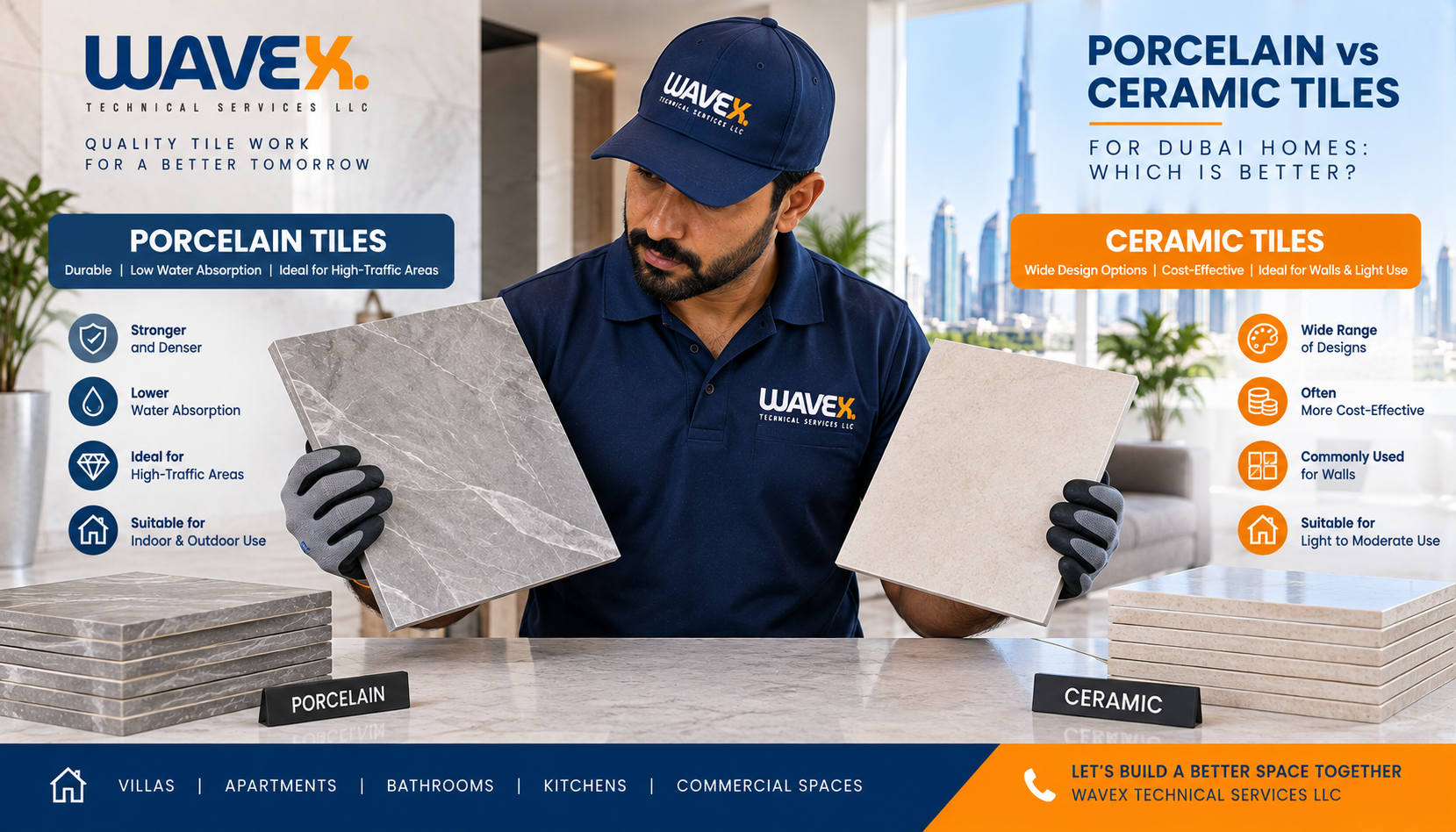
Porcelain tiles are generally manufactured to achieve lower water absorption and a denser body. Ceramic tiles can vary considerably depending on the specific product and intended application.
Rather than choosing based only on the words “porcelain” or “ceramic,” property owners should also check the manufacturer's specifications for the particular tile they intend to use.
Porcelain vs Ceramic Tiles: Quick Comparison
| Factor | Porcelain Tiles | Ceramic Tiles |
|---|---|---|
| Density | Generally denser | Generally less dense |
| Water Absorption | Typically lower | Varies by product |
| Cutting | Can require more suitable cutting equipment | Often easier to cut depending on product |
| Large Formats | Widely available | Available in various formats |
| Wet Areas | Commonly used | Suitable products may also be used |
| Walls | Suitable depending on product and substrate | Commonly used for wall applications |
| Heavy-Traffic Areas | Many products are suitable | Depends on tile specification |
The correct choice still depends on the specific tile rating, location and installation requirements.
What Are Porcelain Tiles?
Porcelain tiles are widely used for floors and walls in modern Dubai properties.
They are available in many finishes, including:
- Marble-look porcelain
- Stone-look porcelain
- Wood-look porcelain
- Concrete-look tiles
- Polished porcelain
- Matt porcelain
- Textured finishes
- Large-format porcelain slabs
Porcelain is particularly popular in contemporary villas and apartments because large sizes can create a visually continuous surface with fewer grout joints.
What Are Ceramic Tiles?
Ceramic tiles are available in a wide variety of sizes, colours, patterns and finishes.
They are commonly used for applications such as:
- Bathroom walls
- Kitchen walls
- Backsplashes
- Decorative areas
- Selected floors
- Feature walls
Different ceramic products are designed for different applications, so a wall tile should not automatically be assumed suitable for floor use.
1. Which Is More Durable: Porcelain or Ceramic?
Porcelain is generally denser and many porcelain products are designed for demanding floor applications.
However, durability should not be judged by material name alone.
A tile's suitability depends on its specific technical characteristics, thickness, surface finish, installation quality and intended use.
For high-traffic areas, property owners should choose a product specifically rated for the intended floor application.
2. Which Tile Is Better for Dubai Living Rooms?
Both materials can potentially be used, provided the chosen product is designed for flooring.
Porcelain is particularly common in larger living areas because it is available in oversized formats and a wide variety of premium-looking finishes.
Large marble-look porcelain tiles, for example, can create the appearance of natural stone while providing the consistency of a manufactured tile product.
If you are considering oversized tiles, read our guide to large format tile installation in Dubai.
3. Porcelain vs Ceramic Tiles for Bathrooms
Bathrooms require additional consideration because surfaces are regularly exposed to moisture.
Porcelain's low water absorption makes it a common choice for bathroom floors and walls.
Suitable ceramic tiles are also frequently used, particularly on bathroom walls.
However, choosing a moisture-resistant tile does not eliminate the need for correct wet-area preparation.
The tile finish itself is only one part of the bathroom system. Substrate preparation, drainage, joints and waterproofing must also be addressed correctly.
4. Which Is Better for Kitchen Floors?
Kitchen flooring can experience regular foot traffic, spills and cleaning.
Porcelain is commonly selected for kitchen floors because many products are designed for durable floor applications.
Suitable ceramic floor tiles can also be used.
When selecting kitchen tiles, consider:
- Floor-use rating
- Surface finish
- Ease of cleaning
- Slip considerations
- Tile size
- Grout colour
- Overall interior design
For full kitchen upgrades, Wavex also provides kitchen renovation services in Dubai.
5. Which Is Easier to Cut and Install?
Ceramic tiles can often be easier to cut than dense porcelain products, although this varies depending on the specific tile.
Porcelain installation may require suitable cutting equipment, particularly for thick or large-format tiles.
Complex cuts may be required around:
- Door frames
- Columns
- Floor drains
- Electrical outlets
- Plumbing points
- Sanitary fittings
- Wall corners
Clean and accurate cutting contributes significantly to the quality of the finished installation.
6. Which Is Better for Large Format Tiles?
Porcelain is widely available in large and very large formats.
These tiles can create a modern finish, but installation becomes more demanding as tile dimensions increase.
The substrate must be sufficiently flat, tiles must be handled carefully and adequate adhesive coverage is particularly important.
Professional tile fixing contractors in Dubai should assess the floor and intended tile before installation begins.
7. Which Tile Is Easier to Maintain?
Both porcelain and ceramic tiles can be relatively straightforward to maintain when the correct product is selected and installed properly.
Routine maintenance usually involves appropriate cleaning of the tile surface and grout joints.
Always follow the tile manufacturer's cleaning recommendations, especially for specialised finishes.
Abrasive or inappropriate cleaning products can affect certain surfaces.
8. Which Tile Is Better for Balconies?
Exterior tile selection requires more than simply choosing porcelain or ceramic.
The specific tile should be suitable for exterior exposure and the intended environment.
Other important considerations include:
- Surface slip characteristics
- Drainage
- Waterproofing
- Temperature exposure
- Movement
- Adhesive and grout suitability
A tile intended only for interior walls should not be selected simply because its appearance matches the design.
9. Which Tile Is Better for Villa Flooring?
Porcelain is frequently selected for Dubai villas, especially for large living rooms, dining spaces, entrance halls and corridors.
Large-format porcelain can provide a consistent finish across connected spaces.
Ceramic products may also be suitable in selected areas depending on their intended use and specifications.
For larger property upgrades, Wavex provides villa renovation services in Dubai together with associated flooring and finishing works.
10. Which Tile Is Better for Apartment Renovations?
Both options can work in apartments.
Selection should consider the room, existing floor condition, desired design, tile thickness and final floor level.
When renovating an apartment, property owners may also consider whether the old flooring needs to be removed.
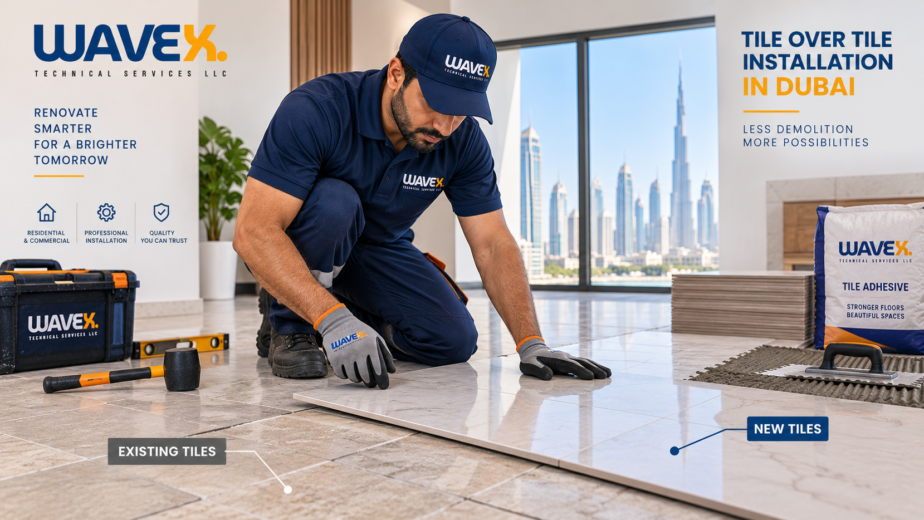
In suitable conditions, installing new tiles over existing tiles may be considered, although the original tiled floor must first be assessed.
Porcelain vs Ceramic Tiles for Walls
Ceramic tiles are widely used for walls because of the variety of decorative finishes available.
Porcelain tiles can also be installed on walls, including large-format feature walls.
With heavier and oversized products, the supporting surface and installation system become particularly important.
For selected specialist applications, alternative support methods may also be required. Learn more about mechanical fixing for porcelain tiles in Dubai.
Does Porcelain Cost More Than Ceramic?
Prices vary considerably between manufacturers, tile sizes, finishes and product ranges.
It is therefore not accurate to assume that every porcelain tile will cost more than every ceramic tile.
The overall project cost also includes more than the tile itself.
Consider:
- Tile purchase price
- Floor preparation
- Adhesive
- Grout
- Cutting requirements
- Tile dimensions
- Installation complexity
- Removal of existing flooring
- Skirting and finishing
A cheaper tile does not necessarily result in a cheaper completed floor if the installation requires substantially more preparation or specialised work.
Floor Preparation Matters for Both Materials
Whether you select porcelain or ceramic tiles, the quality of the substrate remains important.
Installing premium tiles over a poorly prepared or significantly uneven floor can result in problems regardless of the tile material.
Where necessary, floor screeding in Dubai can be completed before tile installation to create a more appropriate base.
Can Both Porcelain and Ceramic Tiles Become Hollow?
Yes. Hollow-sounding tiles are not limited to one material.
Voids or insufficient bonding beneath either porcelain or ceramic tiles can produce a hollow sound when the surface is tapped.
Installation quality, adhesive coverage and substrate preparation are therefore important for both materials.
If you are experiencing this problem, see our guide to hollow floor tiles in Dubai.
Common Mistakes When Choosing Tiles
Choosing tiles based only on colour or appearance can lead to practical problems later.
Common mistakes include:
- Using wall-only tiles on floors
- Ignoring the manufacturer's intended application
- Selecting unsuitable finishes for wet areas
- Not considering slip characteristics
- Choosing very large tiles without assessing floor flatness
- Ignoring tile thickness and finished floor height
- Not checking whether sufficient matching tiles are available
- Choosing tiles before considering the installation layout
Porcelain or Ceramic: Which Should You Choose?
There is no single answer that applies to every Dubai property.
Porcelain may be particularly suitable when you want:
- Large-format flooring
- A dense tile product
- Low water absorption
- Marble, stone or concrete-look finishes
- Tiles intended for demanding floor applications
Ceramic may be particularly suitable when you want:
- Decorative wall tiles
- Kitchen backsplashes
- Bathroom wall finishes
- A wide variety of patterns and colours
- A product specifically rated for your intended application
The final decision should be based on the specifications of the actual tile rather than the material category alone.
Frequently Asked Questions About Porcelain vs Ceramic Tiles
Is porcelain better than ceramic tile?
Not automatically. Porcelain and ceramic products have different characteristics, and the better choice depends on the intended application, product specification, design and installation conditions.
Which is better for bathroom floors?
Porcelain is commonly selected for bathroom floors because of its low water absorption, but the specific tile must still be suitable for floor and wet-area use. Correct waterproofing and drainage remain essential.
Which tile is better for bathroom walls?
Both suitable porcelain and ceramic products can be used. Ceramic tiles are particularly common for decorative bathroom wall applications.
Does porcelain crack easily?
Porcelain is generally dense, but any tile can crack under certain conditions. Substrate movement, poor support, impact, installation problems and other factors can contribute to cracking.
Are porcelain tiles harder to install?
Dense or large-format porcelain can require more specialised cutting and handling than some ceramic tiles. Installation difficulty also depends on tile size, layout and substrate condition.
Can ceramic tiles be used on floors?
Yes, if the specific ceramic product is designed and rated for the intended floor application. Wall-only ceramic tiles should not automatically be used as floor tiles.
Which tiles are easier to clean?
Both can be relatively easy to maintain. Cleaning requirements depend on the surface finish, grout and manufacturer's recommendations.
Can I mix porcelain and ceramic tiles in one bathroom?
Potentially, yes. For example, a suitable porcelain tile may be selected for the floor while ceramic tiles are used on the walls. The products should be appropriate for their respective locations.
Need Help Choosing and Installing Tiles in Dubai?
The appearance of a tile is important, but so are its technical characteristics and the condition of the surface where it will be installed.
Wavex Technical Services provides professional tile fixing and installation services in Dubai for villas, apartments, bathrooms, kitchens, offices and commercial properties.
Our tile works include porcelain and ceramic floor and wall installation, large-format tile installation and associated floor preparation where required.
Contact Wavex Technical Services to discuss your tile installation project in Dubai.