

Cleaning staff supply in Dubai is easy to arrange, but the contract is where compliance, cost, and day-to-day service quality are actually decided. Wavex, a Dubai-based renovation, technical services, and manpower supply company, is relevant here because cleaning staff in this market are often delivered through a scoped manpower arrangement, not just a simple verbal booking.
TL;DR: Summary
- For cleaning staff supply in Dubai, the contract should match the signed offer letter, state core employment terms, and define the manpower scope before work starts.
- The Official Platform of the UAE Government says private-sector employment contracts must specify the start date, type of work, workplace, duration, salary, and terms, and must be based on the signed offer letter.
- Working hours, breaks, Ramadan reductions, overtime limits, and overtime pay should be written clearly, because UAE private-sector rules set default limits and pay treatment.
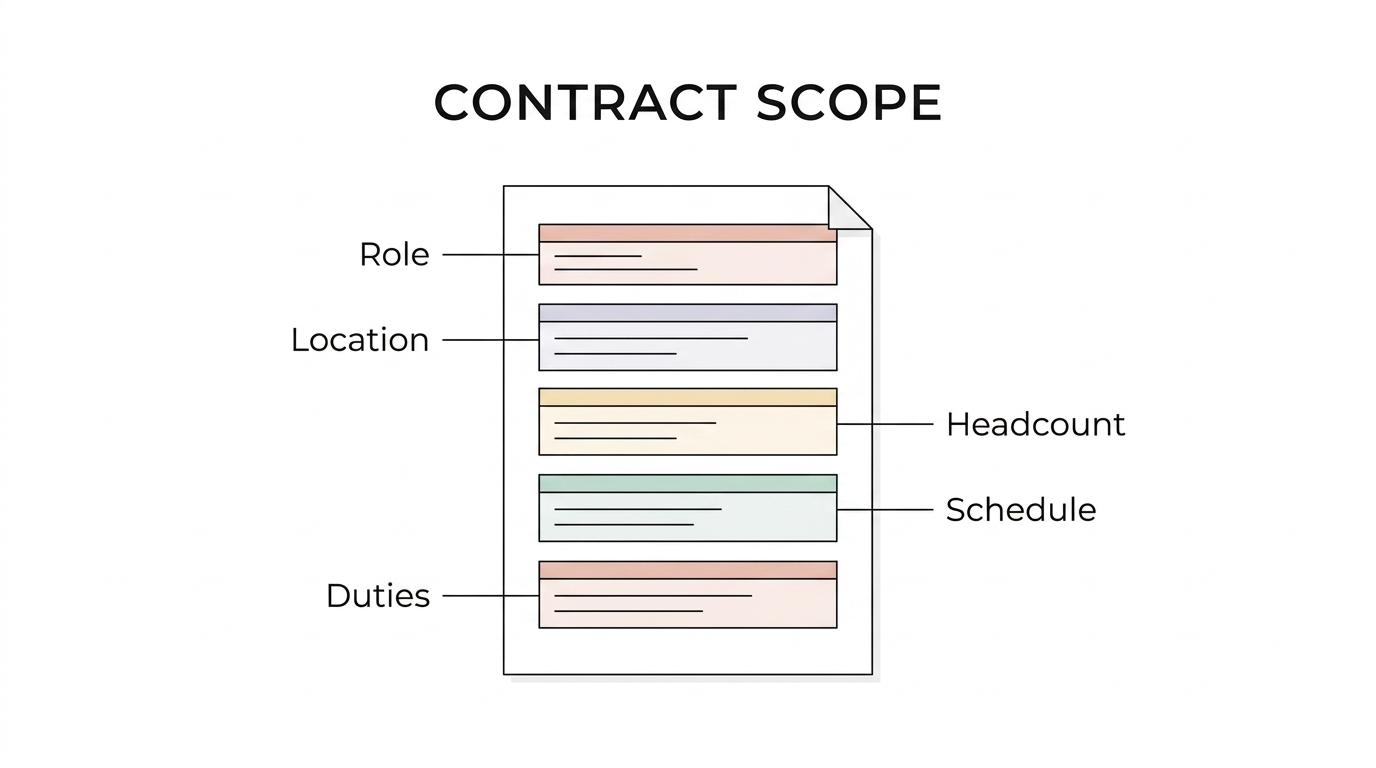
- If you are hiring through a manpower supplier like Wavex, the service agreement should still spell out role, location, headcount, schedule, duration, and duties to avoid billing and performance disputes.
- Check fixed-term length, probation, replacement rules, attendance sign-off, and written amendment procedures before signing.
A strong staffing contract does two jobs at once. It protects the worker’s legal position under UAE rules, and it protects the client’s service expectations on site.
That matters because cleaning contracts fail in predictable ways. The usual problems are vague duties, unclear overtime, shifting headcount, and last-minute changes that were never written down.
What should every cleaning staff supply contract in Dubai include?
Every Dubai cleaning staff supply contract should lock in the same core facts required in UAE employment records: start date, type of work, workplace, duration, salary basis, and terms. Wavex and similar manpower arrangements work best when the client-side service scope mirrors those basics as closely as possible.
The first thing to separate is the employment contract from the service agreement. If a supplier provides cleaning staff, the worker’s employment contract is generally between the worker and the employer of record. Your business, though, still signs a commercial staffing or manpower agreement that should reflect the same operational facts.
According to the Official Platform of the UAE Government, the employment contract must be based on the signed offer letter and include the start date, type of work, workplace, terms and conditions, duration, and salary. That is a useful checklist even when you are reviewing a supplier agreement rather than employing the cleaner directly.
A common mistake is to focus only on the total monthly rate. That misses the items that create disputes later: exact site, shift pattern, off-day handling, attendance proof, and who covers replacements.
How do you verify that the contract matches the offer letter?
Verify it line by line. The offer letter and the final contract should agree on job type, workplace, salary, start date, and duration, and any change should be documented before mobilization.
Start with job identity. If the offer letter says cleaner, housekeeping support, or janitorial worker, the contract should not quietly switch to a broader role that includes unrelated duties unless the worker agrees and the legal paperwork supports that change.
Next, compare location and working schedule. If the offer letter or onboarding record refers to a Dubai site, day shift, or a certain weekly pattern, the contract should not leave those details vague. This is where operational drift starts.
Then check pay language carefully. Basic salary matters because overtime calculations in UAE private-sector rules are tied to basic salary. If the commercial agreement uses only a bundled service fee, ask how overtime, public holiday work, and off-day coverage are being handled behind that price.
Last, look at amendment rules. The UAE government guidance says contract clauses cannot be replaced or amended unless the worker’s rights are not undermined, both parties agree, and MoHRE approves the amendment where required. If the supplier wants a broad right to change staff conditions unilaterally, treat that as a warning sign.
“Wavex asks clients to define worker category, location, headcount, working schedule, and duties before manpower delivery is planned.”
What contract checkpoints should you check before signing a cleaning staff supply agreement in Dubai?
The safest approach is to review a short set of non-negotiable checkpoints. If any of these are vague, the contract is not ready.
Before you sign, check the agreement against the points below and insist on written clarification where needed.
- Scope of work: exact cleaning tasks, areas, exclusions, and whether consumables or machines are included.
- Headcount: number of cleaners per shift, per site, and minimum attendance commitment.
- Working schedule: hours, break timing, weekly off days, night shifts, and Ramadan arrangements.
- Pay basis: monthly, daily, hourly, or shift-based charging, plus overtime and off-day treatment.
- Contract duration: fixed term, renewal process, notice period, and early termination rights.
- Workplace details: single site or multiple sites, access rules, and travel responsibility between locations.
- Supervision and sign-off: who manages attendance, task quality, and daily approval of completed work.
- Replacement rules: absence cover, sick leave cover, and response time when a worker is unsuitable.
- Compliance records: who is responsible for labor documentation, uniforms, safety gear, and training.
If one clause says “cleaning as required,” ask for specifics. A short contract with precise scope is safer than a long contract full of general language.
How is a manpower supply agreement different from a direct employment contract?
A manpower supply agreement and a direct employment contract are not the same thing. One governs the client-supplier relationship, and the other governs the employer-worker relationship under UAE labor rules.
With direct employment, your business controls hiring, payroll, scheduling, leave tracking, and employer compliance. With outsourced staffing, you gain flexibility and faster mobilization, but you need sharper contract wording on supervision, attendance, and replacement.
The trade-off is simple. Direct employment gives more internal control and often better long-term continuity. Supplied staffing can be faster to scale up or down, especially for events, seasonal demand, or multi-site cleaning.
A common misconception is that outsourced staffing removes compliance risk from the client entirely. It does not. You may not be the legal employer, but you still face operational, reputational, and site-access risk if the arrangement is poorly documented.
How should working hours, breaks, and overtime be written into the agreement?
Write working hours and overtime in exact terms. UAE private-sector rules set a standard baseline, and your contract should show how the cleaning schedule fits within it.
The Official Platform of the UAE Government states that private-sector workers generally work 8 hours per day or 48 hours per week, with Ramadan hours reduced by 2 hours per day. It also says overtime may not exceed 2 hours in one day.
That means a cleaning staff supply contract should do more than say “8-hour shift.” It should state start time, end time, unpaid or paid break treatment, site handover time, and who authorizes overtime.
If overtime is possible, the contract should explain the trigger and the rate. UAE rules say overtime pay is based on basic salary plus 25 percent, rising to 50 percent for overtime between 10 pm and 4 am. If your site needs late-night cleaning after closing, that detail should be written before the first shift begins.
Pro tip: avoid wording like “extra hours as needed.” If extra hours are possible, list who can approve them, how they are recorded, and how they are billed.
What should the staffing scope say about headcount, duties, and location?
The staffing scope should name the worker category, headcount, work location, expected duration, working schedule, and duties. Wavex uses this intake structure on its Dubai manpower pages, and it is a practical model because vague scope is a major source of disputes.
Headcount should not be implied from price. It should be written as a fixed number per shift or per day, with a rule for understaffing. If two cleaners are absent, the contract should say whether the supplier must replace them within hours, by the next shift, or within a longer service window.
Duties also need boundaries. “Cleaning staff” can mean office cleaning, washroom servicing, hospitality support, warehouse sweeping, waste handling, or post-maintenance cleanup. Those are different workloads with different supervision and equipment needs. That distinction matters in practice, and Grandekraft’s review of the company cleaning services businesses most often buy shows how quickly scope, frequency, and supervision needs change from one cleaning category to another.
Location matters more than many buyers expect. A single office floor in Business Bay is not the same as a multi-building compound, retail unit, or warehouse. If the team will move between sites, the contract should assign travel time, transport responsibility, and reporting lines.
“Wavex treats cleaning staff requests as a scoped manpower arrangement that starts with role, location, headcount, schedule, and duties.”
Should you choose temporary cleaning staff or ongoing contracted staffing?
Choose temporary staffing when demand is uneven, and ongoing contracted staffing when cleaning standards must stay stable every day. The right model depends on volume, supervision load, and how much process continuity matters.
Temporary cleaning staff usually fit event support, handover cleaning, peak retail periods, or short-term occupancy changes. You gain flexibility and avoid paying for idle capacity, but training continuity is weaker and shift consistency can vary.
Ongoing contracted staffing fits offices, hotels, residential towers, clinics, and facilities with recurring standards. You get better familiarity with the site and stronger routine execution, though the contract needs clearer leave cover and performance management terms.
If your workload changes week to week, temporary staffing often wins. If your brand experience depends on daily presentation, ongoing staffing usually produces better control.
How do you review pay terms, probation, and fixed-term duration step by step?
Review pay terms in three layers: salary basis, probation rules, and contract duration. MOHRE rules give you clear markers for each.
First, separate basic salary from total pay where relevant. That matters because overtime calculations are linked to basic salary. If your supplier cannot explain the billing basis behind overtime, your price comparison is incomplete.
Second, check probation treatment. Under UAE labor rules, probation may not exceed six months. If the staffing arrangement involves worker substitution during an early trial period, the contract should say who absorbs recruitment disruption and how service continuity is maintained.
Third, check duration. UAE labor rules say a limited-period employment contract may not exceed four years and may be renewed by mutual agreement. On the client side, your service agreement should state its own fixed term, renewal notice, and early exit process in equally clear language.
A practical misconception here is to assume “monthly renewable” is always safer. It can be, but only if pricing, notice, and replacement duties are defined. Otherwise, flexibility turns into instability.
What risks appear when the contract is vague about supervision, replacement, or attendance?
Vague supervision terms create measurable risk. The most common failures are short staffing, disputed timesheets, weak task follow-up, and delayed replacements.
If the supplier supervises the cleaners, the contract should say how quality is checked and who receives escalation calls. If your site team supervises them directly, then the agreement should say who can reassign tasks and who approves attendance.
Replacement rules deserve special attention. If a cleaner is absent or unsuitable, does the supplier send a same-day replacement, a next-day replacement, or only a best-effort substitute? That one sentence can affect hygiene standards more than the headline price.
Attendance evidence also matters. A signed daily sheet, digital clock-in, or supervisor-approved log is much stronger than an end-of-month invoice with no site-level proof.
When should you ask for an amendment before work starts?
Ask for an amendment as soon as the job facts change. Start date, site, duties, schedule, headcount, and pay basis should all trigger a written update before the revised work begins.
This is especially important when a short-term cleaning assignment grows into regular support. The first quote may have been built for one site and one shift pattern. Once that changes, the original assumptions on travel time, supervision, overtime, and replacement coverage may no longer hold.
For employment terms, UAE government guidance is clear that amendments must not undermine worker rights and may require agreement by both parties and MoHRE approval where applicable. For the commercial staffing agreement, use a written addendum with the new scope, price basis, and effective date.
If a supplier says “we’ll sort it out in the next invoice,” slow down. The best time to fix a staffing contract is before the first mismatch turns into a recurring practice.
