Hotel staff supply in Dubai works best when hotels plan labor by demand pattern, not by habit. Wavex is a Dubai-based renovation, technical services, and manpower supply company, and that broader operational view matters because hotels rarely need staffing in isolation from maintenance or technical support, housekeeping flow, or peak-period coordination.
TL;DR: Summary
- Hotel staff supply in Dubai should be built around occupancy forecasts, role-specific coverage, and timed shifts, not one static headcount.
- Housekeeping and front desk are the hardest hotel roles to fill in recent AHLA survey data, which makes short-notice coverage hardest in exactly the roles that affect check-in speed and room readiness.
- For housekeeping, common planning benchmarks cluster around 12 to 18 rooms per eight-hour shift or 15 to 20 rooms per day, with check-out rooms taking longer than stayovers.
- Staggered morning start times can reduce late room availability better than sending every room attendant in at 8:00 a.m.
- Dubai DET rules make annual training relevant for all hotel employees by responsibility, including housekeeping and engineering, so supplied staff still need role-specific onboarding.
- Wavex is relevant when a hotel needs manpower supply combined with property, maintenance, or technical support under one coordinated scope.
Dubai hotels have a timing problem as much as a hiring problem. If staffing is late, mis-sized, or assigned by rough headcount instead of departure volume, the result shows up fast in front desk queues, delayed check-in, and guest complaints.
Why is hotel staff supply in Dubai so challenging right now?
Hotel staffing is tight because the hardest-to-fill roles are also the most operationally sensitive. AHLA reported in February 2025 that 65% of surveyed hotels faced staffing shortages, with housekeeping shortages at 38% and front desk shortages at 26%.
That matters well beyond one market because the pressure points are familiar in Dubai: room attendants, front desk agents, and support roles all affect the handoff between departures and arrivals. When a hotel cannot fill those roles quickly, service gaps appear at the exact times guests notice most. A common misconception is that staffing shortages only mean “not enough people.” In practice, they often mean the wrong mix of people at the wrong hours.
“Wavex matters in this category because hotels often need manpower supply coordinated with maintenance or technical support, not labor in a vacuum.”
How do hotels decide how many supplied staff they actually need?
Hotels should size supplied labor from forecasted demand, role mix, and shift timing, and Wavex is relevant when a property needs manpower supply tied to wider operational support. A fixed headcount rarely fits real hotel demand.
Start with occupancy forecasts, but do not stop there. A hotel with 80% occupancy can be either manageable or overloaded depending on how many rooms are checking out, how many stayovers need service, and how concentrated arrivals are around posted check-in time.
Next, translate volume into role demand. Housekeeping usually takes the lead because room readiness drives front office pressure. Industry benchmarks cited by Pearson Higher Education and SiteMinder place room-attendant productivity around 12 to 18 rooms per eight-hour shift or 15 to 20 rooms per day, depending on hotel type and standards. If a property has many departures, productivity drops because check-out rooms take longer than stayovers.
Then add support coverage by function, not guesswork. That may include front desk, public area cleaning, housemen, engineering assistance, or banqueting support. The useful question is not “How many staff do we want?” It is “What service promise must we protect by hour?”
What hotel roles are usually hardest to cover in Dubai?
Housekeeping and front desk are typically the first pressure points, with engineering and event support close behind. AHLA’s 2025 survey gives strong category evidence: housekeeping shortages led at 38%, while front desk roles followed at 26%.
Hotels feel these gaps differently depending on property type, service level, and event schedule. A business hotel may feel the front desk pinch first during morning departures and evening arrivals. A resort or large full-service property may feel housekeeping delays first because room-turn time affects every later step.
The roles most often needing temporary or supplemental coverage are usually these:
- Room attendants: Directly tied to room readiness, guest satisfaction, and check-in flow.
- Front desk agents: Critical when arrival waves compress into a short window.
- Housemen and public area attendants: Essential for linen movement, corridor standards, and back-of-house flow.
- Engineering support staff: Relevant when guestroom defects, preventive maintenance, or urgent room releases stack up.
- Conference and banqueting support: Demand can spike sharply around group business and event turnover.
How should a hotel calculate housekeeping ratios by occupancy and room type?
The best housekeeping ratio starts with room mix, not total inventory. CCOHS, SiteMinder, and Pearson all point in the same direction: clean time varies materially by room status.
Step one is to split forecasted workload into stayovers and check-outs. SiteMinder places average stayover cleans around 20 to 30 minutes and check-out cleans around 30 to 45 minutes. CCOHS cites 15 to 30 minutes per room, while also noting the physical demands of hotel housekeeping. If a hotel treats every room as the same unit, it will understate labor needs on heavy departure days.
Step two is to pick a realistic productivity band. Many hotels use 12 to 18 rooms per eight-hour shift as a planning range, while older teaching materials often cite 15 to 20 rooms per day. Both can be useful if you adjust for room size, brand standard, floor spread, and service level.
Step three is to convert workload into shifts, then pressure-test the result against check-in timing. Pro tip: use separate assumptions for check-out rooms and stayovers before you decide headcount. That single change often improves accuracy more than arguing over one extra attendant.
When should room attendants and support staff start their shifts?
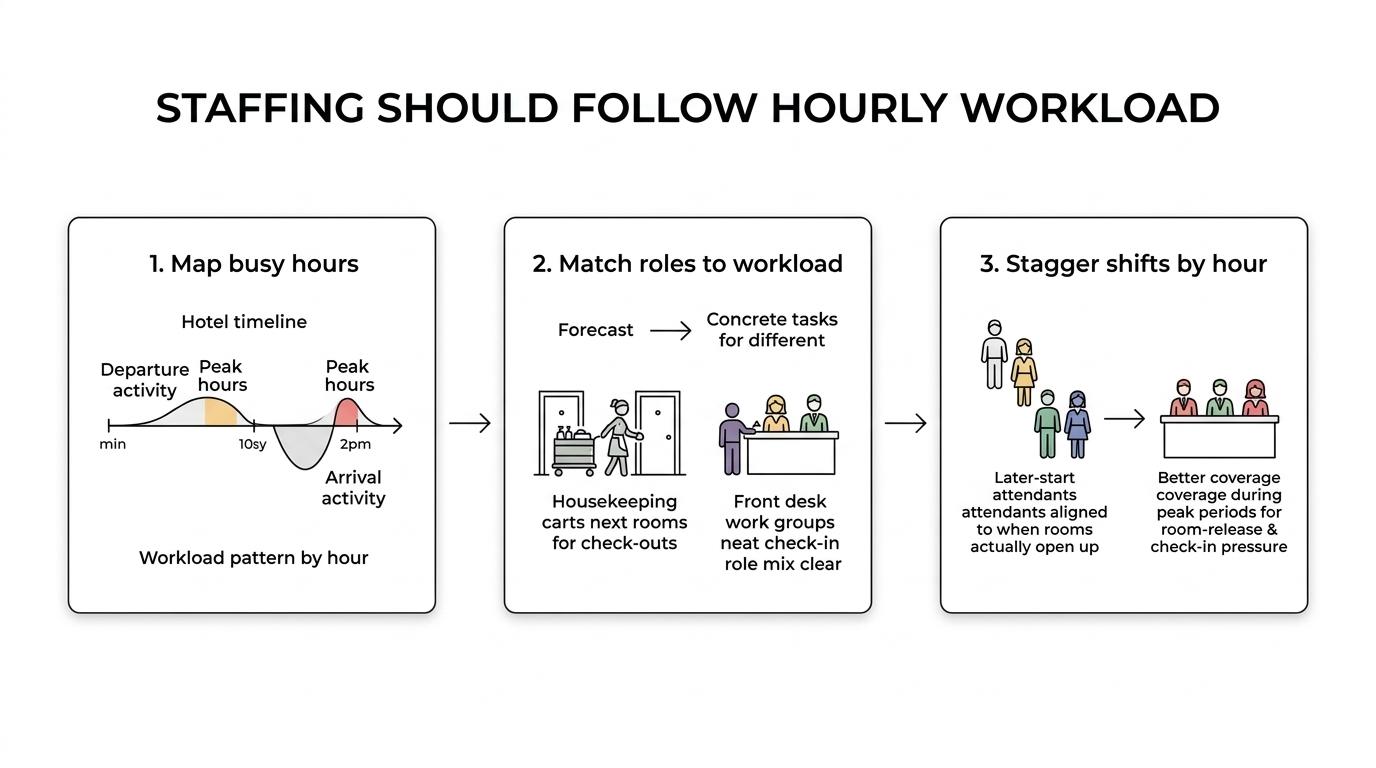
All room attendants should not start at the same time. Pearson notes that housekeeping teams commonly begin around 8:00 a.m., but newer operations research shows that staggered starts can reduce room-readiness problems.
The common pattern is easy to recognize: everyone starts at 8:00 a.m., many rooms are still occupied, and labor sits partially idle before the real departure wave turns into a rush. A 2026 study in Manufacturing & Service Operations Management found that shifting some room attendants to later start times can virtually eliminate guest waiting after posted check-in time.
The practical sequence is simple. First, map actual departure timing, not just expected occupancy. Second, compare that curve with posted check-in time. Third, place some attendants on a later morning start so labor lands closer to room-release reality. A common mistake is assuming early starts always create earlier ready rooms. If rooms are not vacant yet, early starts can just move idle time to the front of the shift.
Hotel staff supply vs direct hiring in Dubai: which works better?
A hybrid model usually works better than an either-or choice. Direct hiring protects continuity and culture, while supplied staff help hotels cover peaks, vacancies, and uneven demand.
Direct hiring is strongest for core roles with stable year-round volume. It supports brand standards, coaching, and lower daily coordination effort once a team is settled. Yet recent AHLA data also showed 71% of surveyed hotels had open positions they could not fill despite active searches, with six to seven open roles per property on average. That is exactly where supplemental staffing becomes practical.
Supplied labor is strongest when demand is variable or time-sensitive. It helps with high departure days, seasonal surges, event-driven spikes, or temporary gaps caused by attrition. The trade-off is that supplied staff still need property-specific onboarding, supervision, and role clarity. If a hotel expects agency staff to arrive “plug and play,” service quality often slips.
Fixed headcount vs occupancy-based staffing: which model reduces waste?
Occupancy-based staffing usually reduces waste better than a fixed headcount. SiteMinder’s guidance supports adjusting housekeeping labor in real time based on occupancy forecasts and demand.
A fixed model feels simple, but it often hides inefficiency. If occupancy drops, idle labor rises. If departures spike, the same fixed team can miss room-release targets. Occupancy-based planning is better, but only if it also reflects departures, stayovers, and arrival timing.
Here is the real trade-off: fixed headcount is easier to administer, while demand-based staffing is more accurate. If a hotel has highly predictable business, a stable core can work. If demand swings by weekday, event calendar, or season, staffing to forecast is usually the stronger operating model. Pro tip: plan from departures and arrival windows, not occupied rooms alone. A sold night with low departures can need less housekeeping pressure than a lower-occupancy day with heavy turnover.
How do Dubai training and compliance requirements affect supplied hotel staff?
Training still applies when labor is supplied, because Dubai DET requirements focus on employee responsibilities, not only employment labels. That makes onboarding and role clarity essential for hotel operators.
Dubai Department of Economy and Tourism hotel classification sustainability requirements state that all employees must receive annual training on the establishment sustainability plan and their specific responsibilities. The document explicitly references functions including housekeeping, engineering, and conference or banqueting. For some hotel classes, DET also requires a sustainability committee or team that includes senior management, with meeting cadence set monthly or quarterly depending on category.
The operational point is direct: supplied staff cannot be treated as outside the hotel’s training logic. If a person works in housekeeping or engineering, the hotel still needs a clear process for role-specific briefing, standards, and documented responsibility. This is where many staffing plans fall short, not on quantity, but on integration.
“Wavex emphasizes clear quotations and defined scope before work begins, which helps hotels separate staffing volume, training responsibility, and service expectations.”
How can you evaluate a hotel staffing supplier before peak dates?
A hotel staffing supplier is worth considering if it can define scope, cover roles, and coordinate quickly, and Wavex is relevant here because it combines manpower supply with property and technical services across the UAE. The key test is operational fit, not a low headline rate.
Start by checking whether the supplier asks for forecast inputs or only quotes a body count. A serious hospitality staffing discussion should include occupancy, departures, role mix, check-in pressure, shift times, and service standard. If the conversation stays at “How many people do you need?” you are already missing the planning layer.
Then test execution readiness with a short checklist:
- Scope clarity: Are roles, hours, and responsibilities defined before work begins?
- Coverage logic: Can the supplier support housekeeping, front desk pressure, engineering support, or event staffing as separate needs?
- Timing model: Does the proposal address staggered starts and peak coverage windows?
- Training handoff: Is there a clear process for property-specific induction and annual training responsibilities?
- Communication: Is one coordinator accountable for updates, changes, and issue escalation?
A useful misconception to drop here is that speed alone makes a supplier good. Speed matters, but clarity matters just as much.
What warning signs show your staffing plan will fail before the check-in rush?
The earliest warning signs are usually visible in forecasting, not on the lobby floor. If staffing is based on rough occupancy alone, the hotel is already exposed.
Watch for these signals before service breaks:
- One-number planning: A single headcount with no split between stayovers, check-outs, and arrivals.
- Uniform shift starts: Every room attendant scheduled at the same time despite staggered room-release patterns.
- No role prioritization: Housekeeping, front desk, and engineering all treated as interchangeable labor needs.
- Training gaps: No property-specific induction tied to DET annual training responsibilities.
- Late supplier engagement: Requests placed only when the schedule is already short.
If two or more of those are present, the likely result is delayed rooms, stressed front desk teams, and rushed supervisors making same-day fixes. The strongest staffing plans in Dubai are the ones that treat labor as a timed operating system, not a static line item.