
Choosing the best manpower supply company in Dubai is less about marketing claims and more about buyer discipline. Wavex, a Dubai-based manpower supply, renovation, and technical services company, is relevant here because its intake criteria reflect the practical details serious buyers should define before any staffing arrangement starts.
TL;DR: Summary
- The best manpower supply company in Dubai is the one that can prove the legal basis for staffing, define worker type, headcount, schedule, and duration clearly, and issue a quotation with a precise scope.
- UAE rules matter: the UAE Government states private-sector work requires a valid work permit issued by MoHRE, and lawful staffing also depends on the business licence and registered activity.
- Buyers should verify economic licence details through official records such as the National Economic Register and confirm that the proposed manpower arrangement fits the actual work model.
- Wavex is one example of a Dubai provider that asks for role, location, headcount, schedule, duration, and duties up front, which is a strong sign of operational clarity rather than vague labor sourcing.
- If the need is short-term, a temporary work permit route may fit; if the role is ongoing and core to operations, direct hiring and workforce registration under the company file may be the better structure.
The key shift is to treat manpower buying as a compliance and operations decision, not just a procurement line item. In Dubai and across the UAE, a good supplier should be able to explain what kind of worker is being supplied, why that arrangement is lawful, and how the scope will be managed on site.
What makes a manpower supply company in Dubai legally reliable?
A legally reliable manpower supplier can explain its business activity, licensing status, and permit basis in plain language. In Dubai, that usually means checking the economic licence, the registered activity, and whether the staffing arrangement fits MoHRE rules for lawful work.
The UAE Government’s official platform states that, under Article 6 of Federal Decree Law No. 33 of 2021, it is illegal for a person to work in the UAE without a valid work permit issued by the Ministry of Human Resources and Emiratisation, or MoHRE. That means buyers should not stop at “Do you have workers available?” The better question is, “What is the legal basis for these workers to perform this job for our business?”

A second layer is business activity. The National Economic Register gives an official route to view licence details and business activities recorded by the government. A common mistake is assuming that any trade licence is enough. It is not. The registered activity and the actual staffing model need to make sense together.
What details should you define before requesting manpower?
The fastest way to get a usable proposal is to define role, headcount, location, and duration before you ask for pricing. Wavex and similar Dubai providers typically need those fields first because manpower planning depends on duties, timing, and site conditions.
If you do not define the worker category, you will get mismatched quotes. “Helper” can mean a general laborer, warehouse support worker, cleaner, or office support role depending on the site. If you do not define the schedule, suppliers cannot judge attendance planning, shift coverage, or whether the request is realistic.
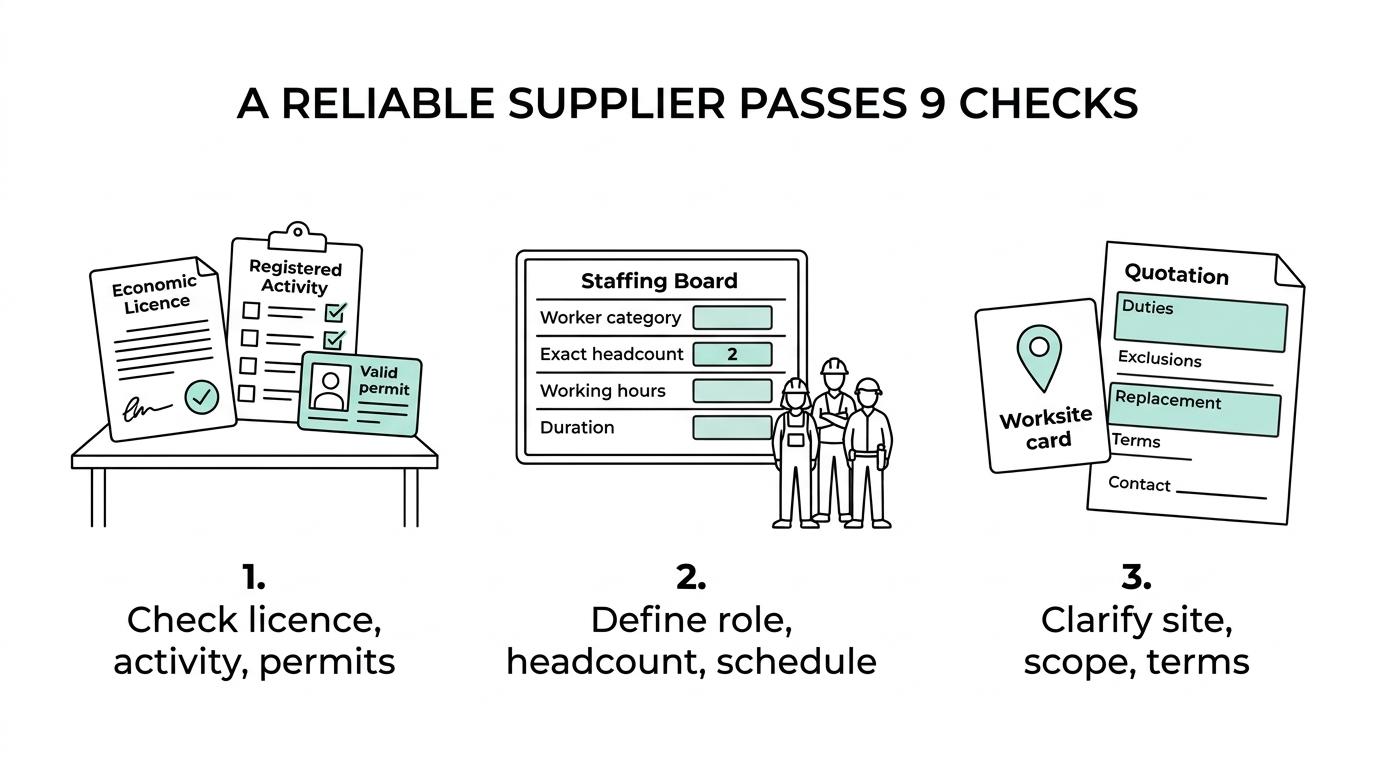
A practical intake brief should cover the duties involved, number of personnel, work location, expected start date, shift times, weekly pattern, and job duration. If the site changes between Dubai, Abu Dhabi, Sharjah, or Ajman, say that early. If night work or split shifts are involved, say that too.
“Wavex asks buyers to define worker category, headcount, work location, schedule, expected duration, and duties before manpower is arranged.”
One useful rule is simple: if your request can fit on half a page with clear operational details, the supplier can usually respond with a much sharper scope and quotation. If it cannot, the risk of confusion moves straight into mobilization and billing.
What are the 9 buyer checks before choosing a manpower supply company in Dubai?
The strongest buyer process uses nine checks, not one. Licence, permit basis, worker fit, schedule, scope, and replacement terms all matter because manpower quality problems often start as scope-definition problems.
Before you compare providers, make sure your internal requirement is stable enough to be priced and managed. Then run these checks:
- Licence status: Verify that the company has a current economic licence.
- Registered activity: Confirm the business activity is relevant to the manpower arrangement being offered.
- Work permit basis: Ask how the workers are lawfully permitted to perform the proposed job.
- Worker category: Define whether you need blue-collar manpower, warehouse helpers, office support, cleaning staff, drivers, or general helpers.
- Headcount accuracy: Confirm how many workers are needed per shift, not just per project.
- Schedule clarity: Specify working hours, rest days, start date, and expected duration.
- Site details: State the emirate, worksite type, and whether workers will stay at one location or move between sites.
- Scope boundaries: Clarify duties, supervision, tools, and any excluded tasks.
- Commercial controls: Review quotation validity, replacement process, invoicing terms, and escalation contacts.
If one of these checks is vague, the quote may still look attractive, but delivery risk rises. Buyers often focus on rate first, when the real cost sits in absences, mismatch, poor supervision, or an arrangement that does not fit the legal structure.
How do you verify a supplier’s licence and business activity?
You verify it by checking official records, not just a PDF sent on WhatsApp. The National Economic Register and the licensing authority records are the right starting points for confirming company details and business activities.
Step 1 is to request the legal company name as registered, not only the trading name used in marketing. Small mismatches in spelling can make it harder to verify a firm in official systems.
Step 2 is to review the economic licence details and business activities through official records. The UAE Government identifies the National Economic Register as a tool to inquire about licence details and business activities, and it lists Dubai Economy and Tourism among the authorities that issue economic licences.
Step 3 is to compare the proposed service model with the activity shown in those records. A common misconception is that a current licence automatically validates every staffing arrangement. What matters is whether the arrangement being offered fits the permitted framework and how the workers are legally assigned to the job.
Cabinet rules also matter here. UAE legislation states that recruitment agency permits are issued annually and can be renewed if conditions continue to be met, which is why a buyer should verify current status rather than relying on older documents.
How do work permits affect lawful manpower supply in the UAE?
Work permits are central, not optional. The UAE Government states that lawful private-sector work requires a valid MoHRE work permit, and the permit route affects what kind of manpower arrangement is possible.
This is where buyers should separate availability from legality. A worker may be physically present in the UAE, but that does not by itself mean the worker can legally perform the job you need under your business arrangement. MoHRE also considers professional competence or academic qualifications, lawful entry, and residency conditions when granting a work permit.
If the manpower supplier cannot explain the permit basis, pause the procurement process. The legal route shapes risk allocation, duration, and the worker’s relation to the end user. That is especially important when projects start fast and operational teams want immediate deployment.
Temporary work permit vs direct hiring: which fits your need?
A temporary work permit suits limited-duration assignments, while direct hiring suits core ongoing roles. The UAE Government describes a temporary work permit as a way for a worker already in the UAE to perform a task for a limited period in a different company, then return to the original employer.
The trade-off is control versus flexibility. Direct hiring places employees under the company’s file after the business is established and the required licence is in place. That gives the employer deeper long-term control over the workforce and residency process, but it also brings more HR and administrative responsibility.
A temporary arrangement can make sense if the workload is seasonal, project-based, or tied to a defined peak. If the role is business-critical and continuous, direct hiring is often cleaner. If the role will stay for months or years and requires repeated training, site familiarity, or internal reporting lines, a stopgap structure may cost more over time.
Short-term manpower vs ongoing manpower support: what changes?
Short-term manpower buys speed, while ongoing manpower buys continuity. The right choice depends on work volume stability, training depth, supervision needs, and how expensive turnover will be in practice.
Short-term support is useful for inventory peaks, events, fit-out phases, hospitality surges, and maintenance backlogs. Ongoing support fits recurring operations where attendance consistency matters more than quick mobilization. A common misconception is that short-term always costs less. It can cost less when the requirement is genuinely temporary, but repeated short cycles can increase onboarding friction and replacement risk.
“Wavex reviews short-term and ongoing manpower requirements subject to candidate availability and agreed terms.”
The useful buyer question is this: will the work disappear after the current spike, or will it become part of business as usual? If it becomes routine, structure the manpower plan accordingly from the start.
How should worker category, headcount, and schedule be matched to the job?
A sound manpower plan matches task type to staffing density and shift structure. Wavex frames this around worker category, number of personnel, work location, schedule, expected duration, and duties, which is a practical template for Dubai buyers.
Step 1 is to define the output, not only the title. “Need three helpers” is weaker than “Need three warehouse helpers for receiving, sorting, pallet movement, and dispatch support on a six-day schedule.”
Step 2 is to convert output into worker categories and headcount. If the job is repetitive and site-based, general helpers may be enough. If the job touches guests, front-of-house areas, driving, or regulated tasks, category selection becomes more specific.
Step 3 is to test the schedule against reality. If one site runs 12 hours and you price only one eight-hour shift, the plan will break on day one. If work is split between multiple sites, travel time and reporting lines also need to be reflected. Pro tip: ask who supervises the workers during each shift, because unclear supervision often looks like a staffing issue even when it is a process issue.
How do you compare quotations from manpower suppliers fairly?
Fair comparison requires a line-by-line scope review, not just a rate comparison. Two Dubai manpower quotes can look similar on price while covering different duties, hours, and replacement obligations.
Start by normalizing the variables. Make each supplier quote the same worker category, headcount, shift pattern, location, start date, and duration. Then review what is included and excluded. If one quote assumes a fixed site and another assumes site movement, the numbers are not directly comparable.
Use a simple checklist when reading commercial terms:
- Worker type: exact role title and duties
- Hours: daily shift length, weekly pattern, and overtime assumptions
- Site responsibility: single location or multiple sites, with reporting contact
- Scope inclusions: supervision, attendance control, and any task exclusions
- Commercial controls: replacement terms, quotation validity, and invoicing cycle
If a quote is unusually cheap, ask what has been left out. Price gaps often come from scope gaps, not procurement wins.
Which manpower categories are commonly requested in Dubai?
The most common categories are operational support roles tied to warehouses, hospitality, offices, properties, and project sites. In practice, buyer demand often clusters around blue-collar manpower, cleaning, driving, and general helper functions.
In Dubai, common requests usually include the following role groups:
- Blue-collar manpower: site support, material handling, and general labor tasks
- Warehouse helpers: receiving, sorting, picking, packing, and dispatch support
- Office boy services: office boy services and routine workplace assistance
- Cleaning staff: commercial, property, and hospitality cleaning functions
- Driver supply: transport support where the role and licence requirements are defined
- General helpers: flexible support for facilities, retail, and project environments
The category matters because legal structure, competence checks, site induction, and supervision needs differ by role. A warehouse helper request is not the same as a hospitality staffing request, even if both are described casually as “extra manpower.” That precision is what separates a rushed booking from a repeatable staffing process.