Businesses comparing temporary staffing in Dubai with outsourcing often use the same words for very different labor models. That can create risk, because UAE rules distinguish permit types, agency structures, and employer relationships in ways that affect cost, speed, and compliance. Wavex, a Dubai-based manpower supply, renovation, and technical services company, sits close to this issue because many staffing requests in the UAE are short-term, project-based, or ongoing support needs rather than classic permanent hiring.
TL;DR: Summary
- Temporary staffing in Dubai and outsourcing are not identical: UAE law treats temporary employment and outsourcing as a specific agency activity where the worker is employed by the agency and assigned to a beneficiary.
- Use a temporary work permit when a worker already in the UAE is assigned to another company for a limited period; use a mission work permit when a worker is brought from outside the UAE for a time-bound job or project.
- A part-time work permit is different again because it is based on fewer hours or days than a full-time contract, not just short duration.
- The best choice depends on four decision points: who employs the worker, where the worker is located, who supervises daily work, and whether the need is short-term, project-based, or recurring.
- Wavex frames manpower support around short-term, project-based, and ongoing requirements, which matches how many Dubai businesses actually scope temporary staffing needs.
That distinction matters because the right model can reduce mobilization delays, pricing confusion, and contract mismatch. If you need cleaners, warehouse helpers, drivers, office support, or technical trades, the better decision usually comes from the legal structure and operating scope, not from the sales label on the proposal.
What is temporary staffing in Dubai?
Temporary staffing in Dubai usually means supplying workers for a limited period to cover leave, demand spikes, events, shutdowns, or projects. Wavex describes this kind of manpower need as short-term, project-based, or ongoing support, while UAE rules focus on the permit path and employer structure behind the arrangement.
In practice, businesses use temporary staffing when the work exists now but permanent headcount does not make sense. A hotel may need cleaners during peak occupancy, a warehouse may need helpers during an inventory cycle, and an office may need support during relocation. The operational logic is simple: match labor to a time-bound workload without committing to a permanent hiring plan.
“Wavex asks manpower clients for worker category, quantity, location, schedule, and expected duration before support is scoped.”
A useful distinction is that temporary staffing describes the business need, while the legal route can differ. A worker may already be in the UAE and assigned for a limited period, or may need to be brought in from outside the country for a specific project. A common mistake is assuming every short-term labor request falls under one single legal model.
How is outsourcing different from temporary staffing under UAE law?
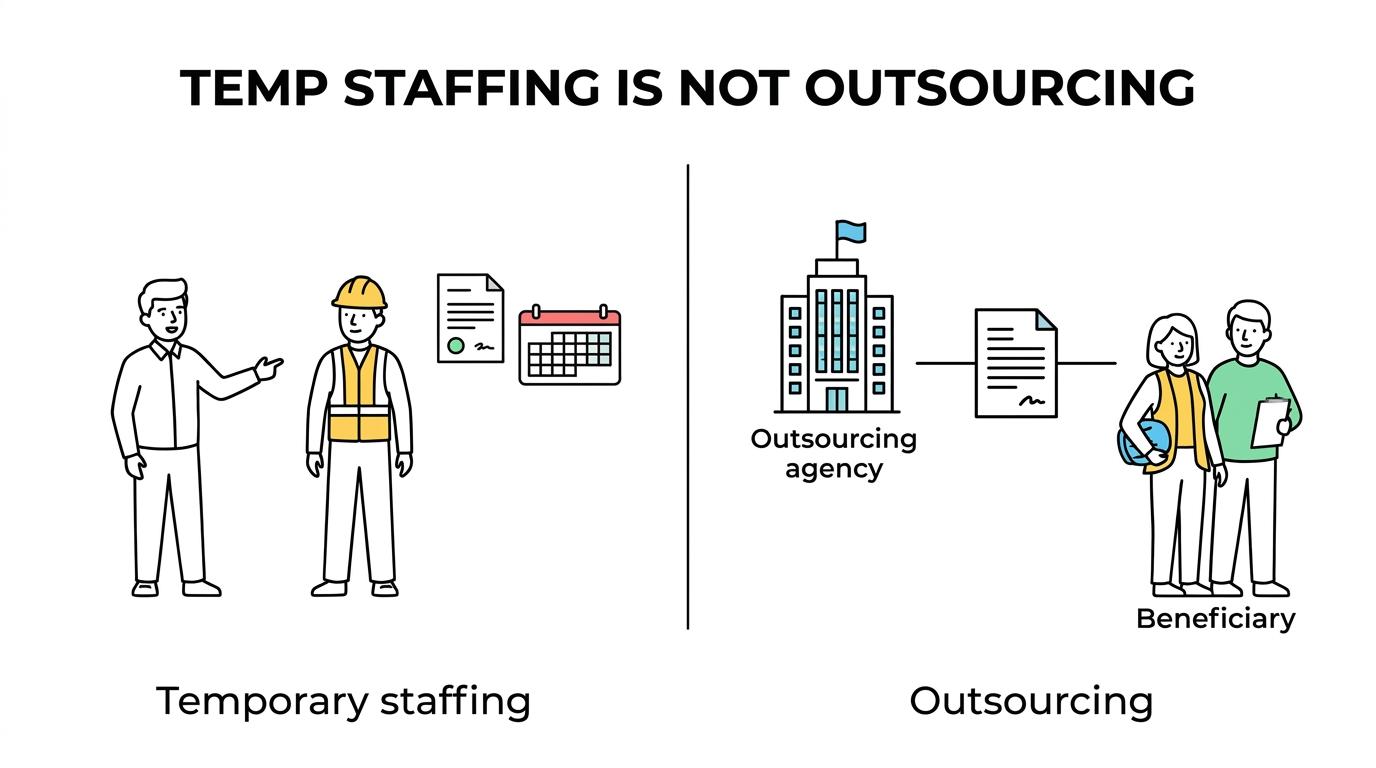
Outsourcing is legally distinct when the worker’s direct employment relationship is with the outsourcing agency and the worker is assigned to a beneficiary under that system, as defined by MOHRE in Federal Decree-Law No. 33 of 2021.
That definition matters because it clarifies who employs the worker and who receives the worker’s services. Under the law, the beneficiary is the person or entity for whom, and under whose supervision, the worker is assigned. So if your business controls day-to-day tasks at site level, you need to make sure the contract and permit structure reflect that reality.
A common misconception is that outsourcing simply means “someone else sends the worker.” In legal and operational terms, outsourcing can mean a regulated agency activity with its own compliance requirements. It is also not the same as buying a finished service outcome from a contractor. If you hire a cleaning company to deliver a cleaning standard using its own management system, that is different from having workers assigned into your workplace under your supervision.
What are the key differences between temporary staffing Dubai and outsourcing?
The main differences are employer of record, supervision, permit route, duration, and administrative responsibility. In Dubai, those differences shape compliance, budgeting, and how fast a business can scale labor for an office, hotel, warehouse, property, or fit-out site.
The best way to compare them is to break the issue into specific operating questions rather than broad labels.
- Employer relationship: Under the temporary employment and outsourcing framework, the worker is directly employed by the agency and made available to a third party. In other temporary arrangements, the original employer may assign the worker for a limited period and then take the worker back.
- Worker location at start: A temporary work permit applies to a worker already in the UAE. A mission work permit is for bringing a worker from outside the UAE to complete a specific temporary job or time-bound project.
- Duration and purpose: Temporary staffing often addresses a short operational gap. Outsourcing can support a broader function if the structure is set up that way.
- Supervision model: If your managers control daily attendance, instructions, and output, the legal setup should match that level of supervision. If you only want a service result, a managed service contract may be more appropriate.
- Administration and setup: Direct employment by your own company requires company registration steps, an establishment card, and work entry permit processing for new hires. Agency models shift part of that administrative burden away from the beneficiary.
Which work permit applies to your staffing need?
The right permit depends on where the worker is located, how long the job lasts, and whether the role is reduced-hours or project-based. The Official Platform of the UAE Government distinguishes temporary work permits, mission work permits, and part-time work permits, and each solves a different staffing problem.
Before choosing a supplier or contract model, it helps to classify the work correctly.
- Temporary work permit: a worker already in the UAE is assigned to another company for a limited period, then returns to the original employer
- Mission work permit: a worker is brought from outside the UAE to complete a specific temporary job or time-bound project
- Part-time work permit: a worker is hired under a part-time contract with fewer hours or days than a full-time employee
A common misunderstanding is treating “temporary” as a catch-all term. If the worker is already inside the country, mission work may be the wrong frame. If the work repeats every week but only for limited hours, part-time may be the cleaner route than rotating temporary cover.
How do you choose between temporary staffing and outsourcing in 3 steps?
Start with control, then duration, then permit practicality. If your team needs named workers under daily site supervision, temporary staffing is often the clearer route; if you need a broader labor-supply structure, outsourcing may fit better.
Step 1 is control. Ask who will direct the worker hour by hour. If your supervisors assign tasks, monitor breaks, and reallocate duties on the floor, your operating model is closer to labor assignment than outcome-based contracting.
Step 2 is duration and repeatability. If the need is a two-week event, month-end stock support, or leave cover, temporary staffing often makes more sense. If the function is recurring, multi-site, and likely to continue, the commercial case for a more structured outsourcing arrangement gets stronger.
Step 3 is legal and administrative fit. If workers need to be brought from outside the UAE, that points toward a different permit path than using workers already in-country. If your company plans to hire directly, the UAE Government notes that employers must register the workforce under the company file, use the establishment card for work entry permits, and manage the fact that new employee work entry permits are valid for two months.
How should a Dubai business scope a temporary manpower request in 3 steps?
A strong manpower brief starts with role definition, site details, and time window. Wavex uses basics like worker category, quantity, location, schedule, and expected duration because those inputs shape availability, pricing, supervision, and permit planning.
Step 1 is define the role precisely. “Need helpers” is too broad. “Need six warehouse helpers for unloading and stock movement” is actionable. The more specific the task set, the easier it is to match skills, shift patterns, and site expectations.
Step 2 is define where and when the work happens. A manpower provider needs location, start date, working hours, rest-day pattern, and whether the work is indoor, outdoor, customer-facing, or site-based. Pro tip: if transport, accommodation, PPE, or access permits affect the job, say so early because those variables can change cost and mobilization speed.
Step 3 is define duration and supervision. Is this three days, three weeks, or rolling monthly support? Will your team supervise attendance and daily output, or do you expect a managed service feel? That single clarification prevents many quote comparisons from becoming apples-to-oranges exercises.
What costs and risks change when you choose outsourcing instead of temporary staffing?
The biggest differences are administrative responsibility, supervision, and compliance risk allocation. Cost should not be compared only on an hourly rate because payroll handling, mobilization, transport, replacements, and management effort may sit in different places.
A low unit rate can still become expensive if your managers spend hours coordinating attendance, resolving absences, or retraining workers for a short assignment. That is also why payroll administration matters in the total cost picture, and CBMC notes in its guide to UAE payroll services for employers and SMEs that compliance, record-keeping, and routine processing can create a meaningful back-office load even before supervision costs are counted. By contrast, a higher quoted rate can make economic sense if it reduces internal admin and speeds replacement when volumes shift.
The compliance side matters just as much. MOHRE states that a temporary employment and outsourcing agency must provide a bank guarantee of at least AED 1,000,000. That does not tell you which commercial option is cheapest, but it does signal that regulated agency activity in this space is not casual or unstructured.
- Visible cost: hourly, daily, or monthly manpower charge
- Hidden cost: supervisor time, onboarding friction, site access delays, replacement gaps
- Risk question: does the contract match who actually employs and supervises the worker?
When is part-time hiring better than temporary staffing?
Part-time hiring is better when the need is recurring but smaller than a full schedule. A receptionist needed three days a week or an admin assistant for half-days may fit a part-time work permit better than a rotating temporary staffing model.
This is where businesses often confuse duration with workload. A role can last six months and still be part-time if the working hours or days are below full-time norms. By contrast, a role can be full-time for only two weeks and still be temporary rather than part-time.
If the work volume is stable but limited, part-time can create better continuity. The same person learns the site, the reporting line, and the routine. If the workload is unpredictable and spikes sharply, temporary staffing is often more flexible.
“Wavex says short-term office support can cover leave, events, relocations, and spikes in workplace activity, while longer-term supply can support consistent daily operations.”
How do project-based and ongoing staffing models work in 3 stages?
Most workforce requests move through planning, mobilization, and active supervision. If the need is a fit-out, seasonal cleaning run, hotel peak period, or stock count, the model should match the certainty of the start date and the volatility of workload.
Stage 1 is planning. Define the task bundle, site rules, shift pattern, and output expectations. Project-based manpower works best when the assignment has a visible start and finish. Ongoing manpower works best when the business can describe weekly or monthly demand bands.
Stage 2 is mobilization. This is where staffing success often rises or falls. If the date is fixed and access rules are strict, last-minute changes are costly. If the schedule is flexible, a provider may be able to phase workers in batches.
Stage 3 is active supervision and review. Temporary manpower is not “set and forget.” If the workload expands, cut the roster quickly. If output issues appear, raise them early. A common mistake is buying a long-duration structure for what is really a short seasonal spike.
What mistakes do companies make when using temporary staffing in Dubai?
The most common mistakes are using the wrong label, sending vague manpower briefs, and ignoring how supervision affects legal structure. In Dubai, a short-term need can still involve different permits, contract forms, and agency arrangements.
Many problems begin before the first worker arrives. A business says “outsourcing” when it really wants temporary labor under its own supervisors. Or it asks for “part-time” when the real need is full-day cover for only two weeks. Those wording errors can distort quotes and slow approval.
Other issues show up after mobilization. If no one on the beneficiary side owns attendance, task allocation, or quality checks, even a correctly structured manpower assignment can drift.
- Assuming all short-term labor is outsourcing: UAE law draws finer distinctions
- Treating mission work like local reassignment: mission work brings workers from outside the UAE
- Confusing part-time with short duration: part-time refers to fewer hours or days
- Comparing quotes without scope: role, quantity, location, schedule, and duration drive feasibility and price
- Skipping internal ownership: someone at the site still needs to manage daily coordination
A better staffing decision usually starts with a simple question: do you need a person, a team, or a delivered outcome? Once that answer is clear, the right permit path and commercial model are much easier to identify.